
Engine swaps are where the Japanese car scene shows its taste, and the taste is remarkably consistent: walk any big import show from SEMA week in Las Vegas to a Sunday meet in a Texas parking lot and the same six engine codes keep turning up under hoods they were never designed for.
That consistency is not an accident. These engines are strong, well documented and, just as important, available thanks to a steady flow of drivetrains pulled from cars retired early in Japan and sold through US importers. Browse a specialist catalog such as texasjdmmotors.com and you can see the supply side of the swap scene in one place, organized by make and model, which says a lot about why certain builds are popular and others stay rare. Here are the six engines that keep winning, and what each one is actually good for.
The inline-six royalty
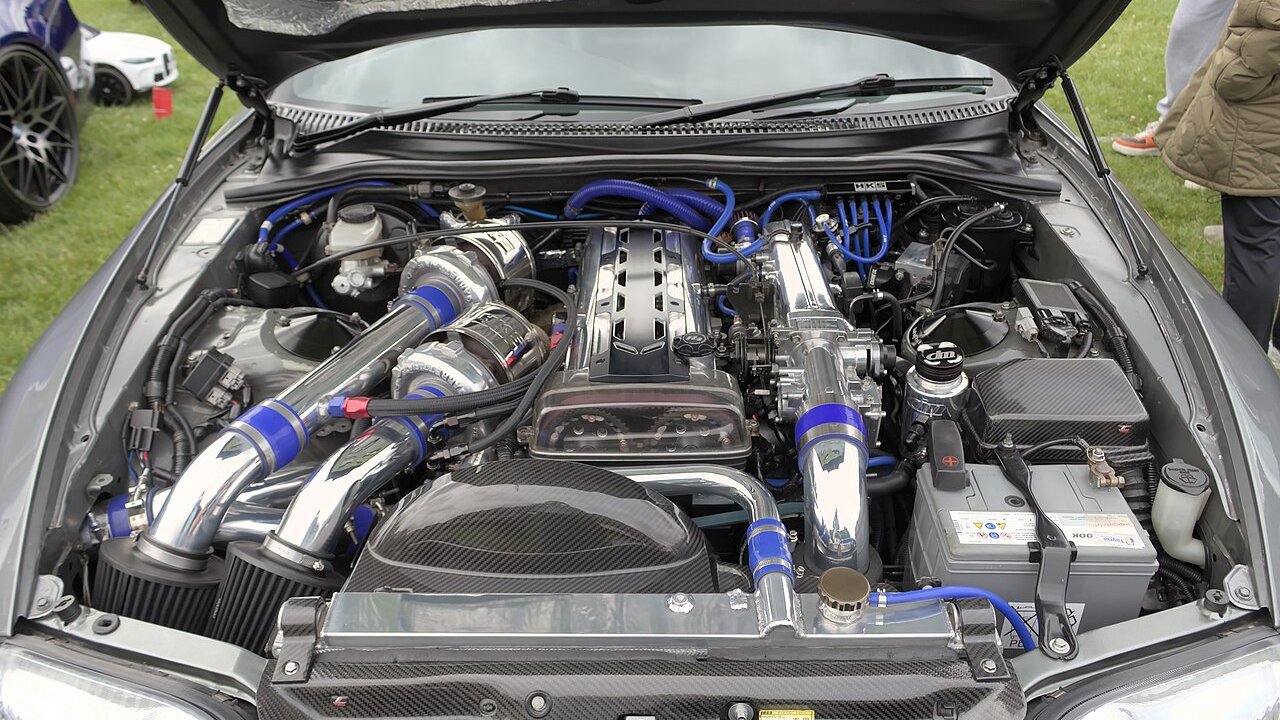
Toyota 2JZ-GTE
The 3.0-liter twin-turbo inline-six from the Mk4 Supra and the Japanese-market Aristo is the engine people name first, and for good reason. Its cast-iron block, forged crank and conservative factory tune, officially held to the 280 PS ceiling Japanese makers observed at the time, leave enormous headroom, and the aftermarket for it is as deep as any engine’s in the world. The catch is price: demand from Supra owners and swap builders has pushed good 2JZ-GTE units well above what most other Japanese engines cost. Builders who want the character without the bill often look at the naturally aspirated 2JZ-GE and add their own turbo.
Read More: What to Look for When Buying Electric Golf Carts in 2026
Toyota 1JZ-GTE
The 2JZ’s smaller sibling, a 2.5-liter turbo six found in cars like the Chaser, Mark II and Soarer, has become the value choice in the drift world. It is shorter than the 2JZ, which helps it fit into chassis like the Nissan 240SX and BMW E36 and E46, and it responds well to bolt-on power. In the US it is also something of a cult item precisely because it was never sold here in a car.
The four-cylinder workhorses
Honda K20 and K24
If one engine family defines the modern swap scene, it is Honda’s K-series. The high-revving K20A from the Japanese Civic Type R and Integra Type R brings the motorsport flavor, while the 2.4-liter K24, used in the Accord, CR-V, Element and Acura TSX, brings torque and low prices. Swap kits exist for older Civics and Integras, Miatas and even Lotus chassis, and the combination of a K24 bottom end with a K20 head is a well-worn recipe for a strong, cheap street engine.
Nissan SR20DET
The 2.0-liter turbo four from the Japanese Silvia and 180SX is the reason so many American 240SX owners never kept the KA24 their cars came with. It bolts into the S-chassis with minimal fabrication, it sounds right, and it suits drifting. Supply is tighter than it used to be, and the youngest examples are now more than two decades old, so careful inspection matters more here than with most engines on this list.
The wildcards
Nissan VQ35DE
Less glamorous, very practical. The 3.5-liter V6 from the 350Z, Infiniti G35, Altima and Murano is everywhere, which keeps prices sensible. It turns up as a replacement in tired Z cars, as a straightforward swap within Nissan’s own range, and occasionally in more ambitious projects where builders want V6 torque without paying turbo-six prices.
Subaru EJ-series
Subaru’s flat-four, in turbocharged EJ20 and EJ25 forms, is mostly swapped within the Subaru family, for example a Japanese-market EJ20 into a US Impreza or WRX, but it also finds homes in Volkswagen Beetle and air-cooled conversions where its low profile helps. Its reputation for head gasket and ringland trouble under heavy tuning means the smart move is buying a well-documented unit and budgeting for the known weak points.
Read More: I Slipped and Fell at Walmart: Do I Have A Case?
How to choose between these engine swaps
The best engine swaps rarely use the most famous engine. Start with the chassis, then budget, then the goal. A light rear-drive car wants a compact engine like the SR20 or 1JZ. A front-drive Honda almost always points to a K-series. A build on a tight budget gets more from a common engine like the VQ35DE or a K24 than from a scarce one. And whatever the code, buy on documented mileage, a compression test and a written warranty, because the swap itself is expensive enough without having to do it twice.
